
Clean a brick paver patio before sealing in six steps: clear it, pull the weeds, pre-treat and scrub the stains, rinse until the water runs clear, dry it properly, then re-sand the joints. Sealer bonds to whatever is underneath it and holds it there until the coating wears off or gets stripped, so prep is most of the job.
- Move the furniture and planters, then sweep or blow off loose debris.
- Pull the weeds and dig out dirty or low joint sand.
- Pre-wet the pavers, apply a paver cleaner, let it sit a few minutes, then scrub with a stiff nylon brush. Oil, rust and white efflorescence each need their own cleaner.
- Rinse with a surface cleaner or garden hose until the water runs clear.
- Let the pavers dry, and pick a window with no rain forecast 24 hours either side of sealing.
- Refill the joints with fresh sand, then seal.
Why Does Cleaning Matter So Much Before Sealing?
Sealer needs to bond to the paver itself. On a dirty paver it bonds to the grime, so when the grime breaks down underneath, the sealer lifts or clouds.
Then there is the cosmetic half. Any stain left behind is now viewed through a glossy clear coat, which makes it darker and more obvious than it was before. Sealing amplifies whatever you leave.
What Has to Come Off the Pavers First?
- Weeds and growth in the joints. Roots out, not snapped off at the surface
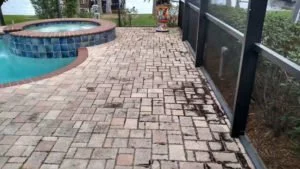
- Mold, algae and mildew. These need a cleaning solution, because pressure alone leaves growth down in the pores
- Oil, rust and tire marks. Each needs its own treatment and plain water moves none of them
- Efflorescence. The chalky white powder that works its way up out of the brick needs a dedicated efflorescence cleaner
- Old or failing sealer. If a previous coating is hazy, flaking or peeling, it has to come off first

Are Brick Pavers and Concrete Pavers Cleaned the Same Way?
Close, but test first. What people call a brick paver might be true clay brick or concrete cast to look like brick, and the two react differently to cleaners. Clay is denser and holds color through the body. Concrete is more porous and carries its color in a surface layer that acid can strip.
Prosoco, which manufactures masonry cleaners, makes the same point: concrete brick and clay brick do not all respond the same way to the same product.
So whatever cleaner you use, try it on a hidden corner first and give it a day before committing to the whole patio.
If you would rather not test cleaners on your own patio, our deck and patio cleaning covers clay brick and concrete pavers both.
Can You Pressure Wash a Paver Patio Before Sealing?
Yes, with the right tool and pressure. A flat surface cleaner is the correct attachment because it rinses evenly across the whole patio at a controlled pressure.
What causes damage is a narrow wand held close. That carves lines into the paver face, blows joint sand out unevenly, and leaves a striped pattern the sealer makes permanent. The goal is cleaning the surface, never eroding it.
Avoid muriatic or undiluted acid, turbo and zero-degree nozzles, and steel wire brushes. Acid strips the surface off concrete pavers, narrow tips carve the face, and wire bristles leave metal behind that rusts into orange specks weeks later.
How Do You Clean Pavers Without a Pressure Washer?
For light dirt and algae you can do the whole job by hand. Pre-wet the pavers, apply a paver cleaner, give it a few minutes to work, then scrub with a stiff nylon brush and rinse with a garden hose.
It takes considerably longer and it suits small patios. The limitation is evenness. A brush leaves subtle variation across a large area that you will only notice once a glossy sealer goes over it, which is why a surface cleaner is worth it on anything being sealed afterwards.
Hand scrubbing also struggles with the spotting that is not really dirt. The black stuff that shows up on a Florida pool deck is usually lichen or mold with a grip on the surface, and it needs a dwell time a brush alone will not give it.

How Long Should Pavers Dry Before Sealing?
If you are doing this yourself with a hose, 24 to 48 hours is the right answer, and in Central Florida treat it as a minimum. Brick holds water well after the surface looks dry, and humidity above 70 percent slows everything down.
Sealing over trapped moisture is what produces the cloudy white haze people panic about afterwards, because the sealer cures over the water instead of letting it escape.
Professional crews work to a different timeline. Our paver sealing is usually cleaned, re-sanded and sealed in a single day, because the cleaning method pulls far more water off the surface than soaking and waiting does, and because the day is picked around the forecast rather than squeezed into a free weekend.
Either way the weather rule is the same. Look for a window with no rain 24 hours before and after, and check the shaded sections and low spots rather than the sunny middle.
Why Does the Joint Sand Have to Be Replaced?
Because sealer locks the joints exactly as it finds them. Sealing over low joints seals in the gap where weeds and ants get back in.
Joint sand also does structural work. It transfers load between pavers so the patio moves as a surface, so low joints mean rocking pavers and an uneven surface. The Concrete Masonry and Hardscapes Association advises topping up joint sand once it drops more than half an inch.
Most installers use polymeric sand, which hardens when activated with water and needs to cure fully before any sealer goes down. We cover the weed side of this in will sealing a paver driveway keep weeds out.
Can You Do This Yourself?
You can clean a paver patio yourself. The parts that go wrong are the ones that are hard to undo:
- Judging whether an old sealer needs stripping, and stripping it fully if so
- Getting the surface evenly clean so the sealer does not blotch
- Knowing when the brick is genuinely dry through
- Sweeping and setting joint sand to the right height
Cleaning mistakes wash off. Sealing mistakes stay. If you are doing other exterior work the same month, work top down and leave the patio until after the roof and house, which we explain in what to pressure wash first.
Paver Cleaning Questions, Answered
Will Dawn dish soap clean pavers?
It shifts light surface dirt and is fine for a quick wash down. It does nothing for algae in the pores, oil, rust or efflorescence, so it is not a prep step before sealing.
What should you never use on pavers?
Muriatic or undiluted acid, turbo and zero-degree nozzles, and steel wire brushes. All three leave damage that a clear sealer then makes permanent.
Can you seal pavers the same day you clean them?
A professional crew can, because the equipment removes far more water and the day is scheduled around the weather. Doing it yourself with a hose, give it 24 to 48 hours.
Should you seal a brick patio at all?
In Florida it is usually worth it. Sealing locks in the color, holds the joint sand in place, and makes oil, rust and mold far easier to lift later. A first sealing typically lasts about 2.5 to 3 years here.
What if my pavers already have a white film?
That is usually efflorescence or a failing previous sealer. Both need treating before anything new goes down. We cover the salt side of it in does salt water damage pavers around a pool.
Want the Prep Done Right Before You Seal?
Cleaning, fresh joint sand and two coats of sealer are one job for us, scheduled around the weather so the brick is genuinely dry before anything goes down. Free estimates across Lakeland and Polk County.